Photo Courtesy: The Good Brigade/DigitalVision/Getty Images
Hepatitis is a condition that causes inflammation of your liver. Currently, there are an estimated 6 million people living with hepatitis in the United States, and more than 50,000 people are diagnosed with this disease every year. There are three primary types of hepatitis, and while their symptoms can be similar, they vary largely in the ways they're transmitted. Learning more about each type of hepatitis can help you better understand the condition as a whole.
Hepatitis A is the most easily transmitted of the three viruses. It affects approximately 2,500 people every year in the United States. It typically spreads through feces-contaminated food or water and is found in the feces of people who have the virus. Hepatitis A causes a short-term, acute sickness that most people heal from without treatment. However, it can cause serious illness in some people. This virus is more common in places with underdeveloped sanitation systems.
While doctors can't treat hepatitis A with medication, people who get this virus can manage its symptoms with fluids, rest and good nutrition. There's also a safe and effective vaccine available to protect you against hepatitis A.
What Is Hepatitis B?
Hepatitis B can occur both acutely (meaning it develops quickly and lasts a short time) and chronically (meaning it develops slowly over time and worsens over months or years). According to the Centers for Disease Control and Prevention, up to 2 million people in the United States are chronically affected with hepatitis B. Hepatitis B can be transmitted through sexual activity and exposure to infected blood. It can also be passed from a parent to their newborn child during birth.
Hepatitis B usually causes short-term discomfort that many people recover from completely after about four to eight weeks. However, it can turn into a chronic condition that lasts for years; this is more likely in older adults. Doctors can treat severe chronic hepatitis B with antiviral medications. However, in most cases, treatments focus on proper hydration and nutrition. There's a safe vaccine available to protect you against hepatitis B, too.
What Is Hepatitis C?
Photo Courtesy: BSIP/Getty Images
Approximately 4 million people in the United States are affected with hepatitis C. This form of hepatitis causes a chronic illness in over 50% of people who get this type of the virus. It's the least transmissible of the three viruses and can spread through contact with infected blood.
Hepatitis C occurs more commonly in people who engage in intravenous drug use. If you received a blood transfusion before 1992, you should also get tested for hepatitis C if you haven't previously. Hepatitis C can spread through unprotected sexual intercourse, but this is a less common way to transmit it. While there's no vaccine for chronic hepatitis C, treatments that are available today offer a 95% cure rate.
Chronic hepatitis C can significantly affect how your liver works. It can cause cirrhosis, which means that your normal liver tissue is replaced with scar tissue. It can also cause liver cancer. However, there are medications that can help keep this disease in check. Making lifestyle changes, such as reducing or eliminating alcohol from your diet, can also decrease your chances of experiencing complications. In severe cases, hepatitis C may require a liver transplant.
The varying forms of viral hepatitis affect millions of people in the United States. Chronic hepatitis often has few symptoms in its early stages, so recognizing the associated dangers and getting tested if you've been exposed may save your life. Although there are five types of viral hepatitis, only A, B and C are the forms commonly found in the United States.
Resource Links:
"Hepatitis A, B, and C: Learn the Differences," Immunization Action Coalition
"What's the Difference Between Hepatitis A, B and C?," UNC Health Talk
"The ABCs of Hepatitis," Centers for Disease Control and Prevention
"What's the Difference: Hepatitis B vs Hepatitis C?," Hepatitis B Foundation
Vitamin E is a compound that plays many important roles in your body and provides multiple health benefits. In order to maintain healthy levels of vitamin E, you need to ingest it through food or consume it as an oral supplement. Read on to find out which foods are recommended sources of this essential nutrient, along with other basics to know about vitamin E.
Vitamin E is classified as an antioxidant. This means that vitamin E helps to destroy harmful compounds called free radicals that can build up in your body. Free radicals cause damage to cells through oxidative stress, and they've been linked to aging and health problems such as cancer and heart disease. Getting enough vitamin E on a daily basis may help to combat these conditions by protecting the outer membranes of your cells from free radical damage.
Photo Courtesy: Leren Lu/Photodisc/Getty Images
Vitamin E also plays an important role in your immune system and your body's ability to fight infection. At certain doses, vitamin E has been shown to stimulate the function of T cells — a type of cell that responds to pathogens that cause disease. Recent studies have shown that increasing your vitamin E intake may correlate with a stronger immune response and greater resistance to infection.
Vitamin E is present in the following whole foods:
As people age, their daily dosage recommendation for vitamin E increases. For these standard recommended daily doses, a healthy balanced diet is usually sufficient for getting the required amount of vitamin E:
Photo Courtesy: skynesher/E+/Getty Images
Birth to 6 months: 4 milligrams (mg)/day
1 to 12 months: 5 mg/day
1 to 3 years: 6mg/day
4 to 8 years: 7mg/day
9 to 13 years: 11mg/day
14+ years, including adults and seniors: 15mg/day
A person's age, gender and health conditions can help determine their recommended daily dose of vitamin E. Always consult a healthcare professional before altering your intake of vitamin E from the recommended daily dosage.
Taking Vitamin E Supplements
If it becomes necessary, such as if you become deficient in vitamin E, your doctor may advise you to start taking vitamin E supplements. Vitamin E supplements may come with some minor side effects if you take more than the recommended daily amount or if you combine these supplements with certain medications.
Photo Courtesy: Moyo Studio/E+/Getty Images
For example, vitamin E may increase the risk of bleeding if you take it with anticoagulants (also called blood thinners) like warfarin. Other medications, like chemotherapy drugs and cholesterol-lowering drugs, have potential harmful interactions when combined with vitamin E supplements. Talk to a healthcare professional before introducing daily vitamin E supplements, and be sure to discuss current medications you're taking.
Signs of a Vitamin E Deficiency
Because most people are able to get a sufficient amount of vitamin E through their normal daily diet, vitamin E deficiency is rare and typically related to an underlying health issue. For example, because vitamin E is a fat-soluble nutrient, there's a risk for vitamin E deficiency in people whose bodies are unable to absorb fat properly. Premature infants may also become deficient in vitamin E.
Photo Courtesy: LaylaBird/E+/Getty Images
When vitamin E deficiency does occur, these are some of its common symptoms:
Muscle weakness
Unsteady gait
Nerve pain or numbness
Impaired vision
Vitamin E deficiency can be detected with a blood test. It typically resolves with minor changes in your diet or the addition of vitamin E supplements. It's important to address any out-of-range vitamin E levels with your doctor. Chronic deficiencies may prevent your immune system from functioning normally.
Under-eye dark circles troubled many in 2020, and we have disrupted sleeping patterns, longer screen time and puffy eyes to thank for it. But, there is a cure and we may not have to deal with it in the current year.
Dr Pankaj Chaturvedi, a dermatologist at the launch of Kiehl's India Powerful-Strength Line-Reducing and Dark Circle Diminishing Vitamin C Eye Serum, explained over a Zoom call the different kinds of dark circles and why one of the most hyped ingredients in the beauty industry at the moment is vitamin C. Read on.
When it comes to taking care of our under eyes, preventative solutions work best. (Photo: Getty Images/Thinkstock)
How are under-eye dark circles formed?
Not just a bad sleeping pattern, but numerous causes such as heredity, age, mental or physical stress, hormonal changes, dietary deficiencies lead to the formation of dark circles. In fact, Dr Chaturvei shared that too much sun exposure is also a cause, causing the body to create more melanin, the pigment that gives the skin its colour. "As we age, the reddish-blue blood vessels under your eyes will become more visible by thinning skin and losing fat and collagen."
This is why preventative solutions work best. He explained that as soon as one starts noticing the first signs of ageing such as dryness, they must begin taking care rather than waiting for a later stage.
What are the various kinds of dark circles?
Dr Chaturvedi stated there are four types of under-eye dark circles. He also shared an easy way to help you find which category yours belong to. "A simple way would be to lightly stretch the eyelid skin — you will either find your eyelids slightly blue. Otherwise, there would be no alteration in brown under-eye circles."
Blue dark circles are the result of superficial blood vessels being visible through the thin skin of the eyelids. These are vascular under-eye circles. Here, the puffiness can or cannot be visible.
Brown dark circles are a result of the pigment in the skin, which can be hereditary. Not only that, but this could also be because of the structural area which is associated with grooves caused by loss of fat in the face, in turn, making the under-eye crevice seem slightly darker because of a bony face structure.
If you have tear trough dark circles, they are simply caused by the shadow of the structure.
There are also dark circles caused by allergies through dermatitis or excessive rubbing of eyes.
Why vitamin C will work best
Vitamin C strengthens your skin. "It produces collagen that makes the skin more elastic and resilient. High in antioxidants, vitamin C-rich foods help minimise the damage caused by free radical exposure, by boosting blood circulation. This helps restore the stiffness and glow of the skin."
Vitamin C can be applied topically, but it is precarious in nature, which is why the dermatologist advises: "The apt concentration of vitamin C should be 10 per cent." He points out this can be drying on the skin and one should pair it with either a tri-peptide complex or hyaluronic acid.
For more lifestyle news, follow us: Twitter: lifestyle_ie | Facebook: IE Lifestyle | Instagram: ie_lifestyle
Good nutrition is important to keep your eyes healthy and functioning their best throughout your lifetime. Two very important eye nutrients that may reduce your risk for macular degeneration and cataracts have names you may not be familiar with: lutein (LOO-teen) and zeaxanthin (zee-ah-ZAN-thin).
Lutein and zeaxanthin are two types of carotenoids (kuh-RAH-teh-noids), which are yellow to red pigments found widely in vegetables and other plants. Though lutein is considered a yellow pigment, in high concentrations it appears orange-red.
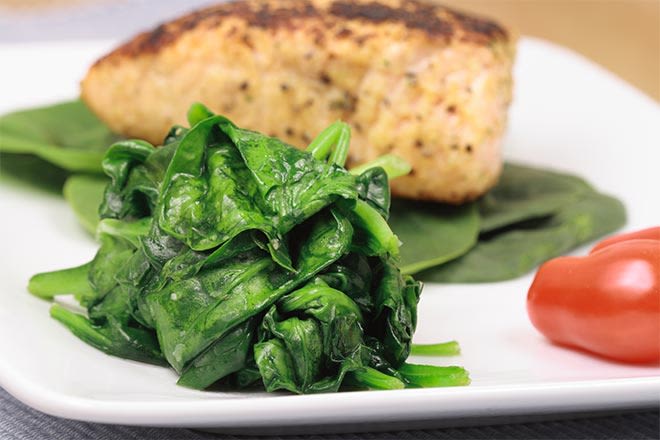
Cooked spinach is one of the best natural food sources of lutein and zeaxanthin.
In nature, lutein and zeaxanthin appear to absorb excess light energy to prevent damage to plants from too much sunlight, especially from high-energy light rays called blue light.
In addition to being found in many green leafy plants and colorful fruits and vegetables, lutein and zeaxanthin are found in high concentrations in the macula of the human eye, giving the macula its yellowish color. In fact, the macula also is called the "macula lutea" (from the Latin macula, meaning "spot," and lutea, meaning "yellow").
Recent research has discovered a third carotenoid in the macula. Called meso-zeaxanthin, this pigment is not found in food sources and appears to be created in the retina from ingested lutein.
Lutein and zeaxanthin appear to have important antioxidant functions in the body. Along with other natural antioxidants, including vitamin C, beta-carotene and vitamin E, these important pigments guard the body from damaging effects of free radicals, which are unstable molecules that can destroy cells and play a role in many diseases.
In addition to important eye and vision benefits, lutein may help protect against atherosclerosis (buildup of fatty deposits in arteries), the disease that leads to most heart attacks.
Eye benefits of lutein and zeaxanthin
It is believed that lutein, zeaxanthin and meso-zeaxanthin in the macula block blue light from reaching the underlying structures in the retina, thereby reducing the risk of light-induced oxidative damage that could lead to age-related macular degeneration (ARMD).
A number of studies have found that lutein and zeaxanthin either help prevent ARMD or may slow progression of the disease:
Research published in Nutrition & Metabolism found that a nutritional supplement containing meso-zeaxanthin, lutein and zeaxanthin effectively increased the optical density of the macular pigment in eyes of the majority of human subjects. The macular pigment is believed to offer protection against the development of macular degeneration.
Studies published in American Journal of Epidemiology, Ophthalmology and Archives of Ophthalmology found higher levels of lutein and zeaxanthin in the diet are associated with a lower incidence of AMD.
Two studies published in Investigative Ophthalmology and Visual Science found that eyes with greater levels of macular pigments were less likely to have or develop macular degeneration.
In research published in Archives of Biochemistry and Biophysics, the study authors conclude that lutein, zeaxanthin and meso-zeaxanthin filter short-wavelength light and prevent or reduce the generation of free radicals in the retinal pigment epithelium and choroid. They also suggest that a mixture of these carotenoids is more effective than any one of the individual carotenoids at the same total concentration.
In a study published in the journal Optometry, participants with early AMD who consumed 8 mg per day of dietary zeaxanthin for one year improved their night driving and their visual acuity improved an average of 1.5 lines on an eye chart.
In May 2013, the much-anticipated results of the second large-scale Age-Related Eye Disease Study (AREDS2) sponsored by the National Eye Institute were published.
AREDS2 was a follow-up to the original 5-year AREDS study published in 2001, which found use of a daily antioxidant supplement containing beta-carotene, vitamin C, vitamin E, zinc and copper reduced the risk of progressive AMD by 25 percent among participants with early and intermediate macular degeneration.
The goal of AREDS2 was to evaluate the effect of other nutrients — including lutein and zeaxanthin — on the prevention of AMD and other age-related eye diseases. AREDS2 also investigated the effect of removing beta-carotene from the AREDS supplement, since supplementation of this vitamin A precursor has been associated with increased risk of certain cancers among smokers and previous smokers.
The AREDS2 results revealed study participants with early signs of macular degeneration who took a modification of the original AREDS nutritional supplement that contained 10 mg lutein and 2 mg zeaxanthin (and no beta-carotene) every day for the 5-year study period had a 10 to 25 percent reduced risk of AMD progression. Study participants whose diets contained the lowest amounts of foods containing natural lutein and zeaxanthin experienced the greatest AMD risk reduction from taking the daily nutritional supplement.
While AREDS2 and other studies provide evidence that lutein and zeaxanthin may play a role in preventing macular degeneration (or at least reducing the risk of progression of AMD), it's less clear if these carotenoids help prevent cataracts.
Research published in Archives of Ophthalmology suggests women whose diets include high amounts of healthful foods containing lutein, zeaxanthin and other carotenoids have a lower risk of cataracts than women whose diets contain lower amounts of these nutrients.
In AREDS2, however, supplemental lutein and zeaxanthin had no effect on cataract risk or progression.
Eye Nutrition News
Book explains how to eat better for healthy eyes
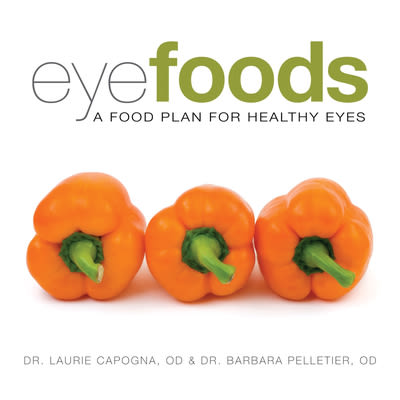
Eyefoods: A Food Plan for Healthy Eyes is a new book designed to help you improve the health of your eyes.
Written by doctors Laurie Capogna, OD, and Barbara Pelletier, OD, the book describes nutrients such as lutein, zinc and vitamin C and tells you which foods they are found in and how much you need each day to help maintain healthy eyes.
The book also presents research that links good nutrition to reduced risk of eye disease, as well as quick recipes for incorporating eye-healthy vitamins and minerals in your daily diet. The text is easy to understand, and the big, colorful food photos will inspire you to eat better.
Eyefoods is available at eyefoods.com.
Foods containing lutein and zeaxanthin
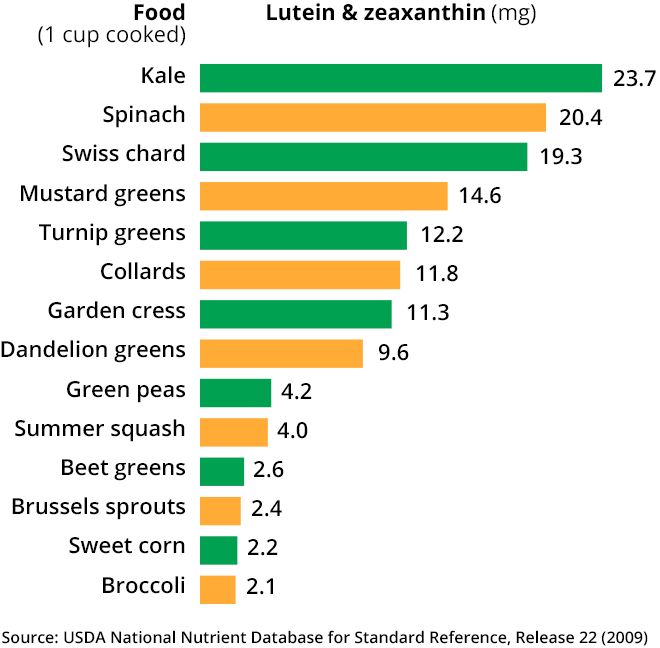
The best natural food sources of lutein and zeaxanthin are green leafy vegetables and other green or yellow vegetables. Among these, cooked kale and cooked spinach top the list, according to the U.S. Department of Agriculture (USDA).
Non-vegetarian sources of lutein and zeaxanthin include egg yolks. But if you have high cholesterol, you're much better off getting most of these yellow nutrients from fruits and vegetables.
Lutein and zeaxanthin supplements
Lutein & zeaxanthin foods.
Because of the apparent eye and cardiovascular benefits of lutein and zeaxanthin, many nutritional companies have added these carotenoids to their multiple vitamin formulas. Others have introduced special eye vitamins that are predominantly lutein and zeaxanthin supplements.
There currently is no Recommended Dietary Allowance (RDA) or Recommended Daily Intake (RDI) for lutein or zeaxanthin, but some experts say you should ingest at least 6 milligrams (mg) of lutein per day for beneficial effects.
It remains unclear how much lutein and zeaxanthin is needed daily for adequate eye and vision protection. Also, it is unknown at this time whether supplements have the same effect as lutein and zeaxanthin obtained through food sources.
There are no known toxic side effects of taking too much lutein or zeaxanthin. In some cases, people who eat large amounts of carrots or yellow and green citrus fruits can develop a harmless yellowing of the skin called carotenemia. Though the appearance of the condition can be somewhat alarming and may be confused with jaundice, the yellow discoloration disappears by cutting back on consumption of these carotenoid-rich foods. (Carotenemia also can be associated with over-consumption of carotenoid-rich nutritional supplements.)
Popular lutein and zeaxanthin supplements include:
MacuHealth with LMZ3 (MacuHealth LLC)
EyePromise Zeaxanthin (Zeavision)
ICaps Eye Vitamin Lutein & Zeaxanthin Formula (Alcon)
Macula Complete (Biosyntrx)
MacularProtect Complete (ScienceBased Health)
MaxiVision Ocular Formula (MedOp)
OcuGuard Plus (TwinLab)
Ocuvite (Bausch + Lomb)
The source of lutein in many lutein supplements is marigold flowers, while for zeaxanthin it is often red peppers. If you choose a lutein and zeaxanthin supplement, make sure it's a high quality product from a reputable dietary supplement company.
Remember that taking dietary supplements does not replace a healthy diet. Eating a well-balanced diet that includes plenty of fruits and vegetables usually is the best way to get the important eye nutrients you need.
If you have low macular pigment levels and are sensitive to light, ask your eye care professional about photochromic lenses. These eyeglass lenses protect your eyes from UV and high-energy visible blue light that can damage retinal tissue, and they darken automatically in sunlight to ease light sensitivity.
Also, remember that individuals sometimes react differently to certain supplements, which can have unintended effects such as adverse reactions with medications. Consult with your GP or optician before trying any vision supplements.
Eye Nutrition News
Animal study finds nutritional supplements reduce risk of diabetic retinopathy
Nutritional supplements containing lutein and zeaxanthin, lipoic acid, and omega-3 fatty acids are effective in preventing the development of retinopathy among diabetic rats, according to a study.
Researchers at the Kresge Eye Institute in Detroit investigated the effect of carotenoid-containing supplements on retinal oxidative stress and inflammation and the development of diabetic retinopathy.
Diabetes was induced and confirmed in all rats in the study, and then some rats were given a diet that included the nutritional supplements while others were given the same food but without the supplements. After 11 months, the retinas of the rats were evaluated for changes in blood vessels, cellular damage and other retinal changes characteristic of diabetic retinopathy.
In rats that had not received the nutritional supplements, diabetes-induced damage to retinal blood vessels was three to four times greater than among rats who had received the added nutrients.
The study authors concluded that the nutritional supplements used in this study prevented diabetic retinopathy and preserved normal retinal functioning. They also said that, though human testing is required to confirm, these supplements "could represent an achievable and inexpensive adjunct therapy" to inhibit diabetic retinopathy in people with diabetes.
A full report of the study was published online in January 2014 by Nutrition & Metabolism.
Shereen Jegtvig, Certified Nutrition Specialist (CNS), also contributed to this article.
Lutein + zeaxanthin and omega-3 fatty acids for age-related macular degeneration: The Age-Related Eye Disease Study 2 (AREDS2) randomized clinical trial.JAMA. Published online May 2013.
NIH study provides clarity on supplements for protection against blinding eye disease. National Eye Institute (NEI) press release issued May 2013.
Anti-inflammatory effects of lutein in retinal ischemic/hypoxic injury: in vivo and in vitro studies.Investigative Ophthalmology & Visual Science. Published online August 2012.
Studies on the singlet oxygen scavenging mechanism of human macular pigment.Archives of Biochemistry and Biophysics. August 2010.
Healthy diets and the subsequent prevalence of nuclear cataract in women.Archives of Ophthalmology. June 2010.
Associations between age-related nuclear cataract and lutein and zeaxanthin in the diet and serum in the Carotenoids in the Age-Related Eye Disease Study (CAREDS), an ancillary study of the Women's Health Initiative.Archives of Ophthalmology. March 2008.
Dietary antioxidants and the long-term incidence of age-related macular degeneration: the Blue Mountains Eye Study.Ophthalmology. February 2008.
Dietary carotenoids, vitamins C and E, and risk of cataract in women.Archives of Ophthalmology. January 2008.
Macular pigment response to a supplement containing meso-zeaxanthin, lutein and zeaxanthin.Nutrition & Metabolism. May 2007.
Associations between intermediate age-related macular degeneration and lutein and zeaxanthin in the Carotenoids in Age-Related Eye Disease Study (CAREDS).Archives of Ophthalmology. August 2006.
Oxygenated carotenoid lutein and progression of early atherosclerosis: the Los Angeles atherosclerosis study.Circulation. June 2001.
Lutein and zeaxanthin in the diet and serum and their relation to age-related maculopathy in the Third National Health and Nutrition Examination Survey.American Journal of Epidemiology. March 2001.
Macular pigment and risk for age-related macular degeneration in subjects from a Northern European population.Investigative Ophthalmology and Visual Science. February 2001.
Macular pigment in donor eyes with and without AMD: a case-control study.Investigative Ophthalmology and Visual Science. January 2001.
For all health enthusiasts, the prime importance is to have the right nutrition. However, excessive work pressure, stress and poor lifestyle result into unhealthy and improper eating, causing a wide range of health issues and ailments. Therefore, Vitaminshop.ae brings to you premium-quality online supplements UAE, all within one roof. We let you choose, compare and buy the right nutritional supplements that are suitable for your health.
Show more...
Health Supplements We Offer
We are one of the most trusted portals to buy supplements online UAE, serving millions of health-conscious customers in achieving their fitness goals. Here, you can browse through a wide range of vitamins & supplements that cater to general health as well as specific conditions such as heart health, digestive support, immunity and antioxidant, energy metabolism, joint and bone health, prenatal health, eye health, brain support, and many others.
One of our trending products is Vitamin C supplement, known for its antioxidant properties that help the body against chronic diseases. The essential vitamin may aid in lowering the risk of heart diseases and supports optimal blood pressure levels. In addition to Vitamin C supplement, other health boosters enriched with Vitamin D3, Calcium, Salmon Oil, Omega-3 fatty acids, iron and probiotics are also in high demand.
Highest Quality Guarantee
Vitaminshop.ae is a premier online supplement store in UAE that guarantees superior quality and authenticity of the products we sell. We have online supplements in UAE only from the top brands that perform stringent testing procedures to ensure purity, potency and quality.
A vast selection of nutritional products to compare and buy
Highest quality and safety standards
Get only pure and authentic products
Easy return and money-back guarantee
Prompt shipping all across UAE
To buy supplements online in UAE, order today. We provide a simple and hassle-free process to buy supplements online.
Vitamin C atau asam askorbat (ascorbic acid) adalah vitamin yang diperlukan untuk mencegah dan mengatasi kekurangan vitamin C. Kekurangan vitamin C bisa menyebabkan terjadinya penyakit skorbut atau scurvy. Selain itu, vitamin C juga memiliki efek antioksidan yang dapat membantu tubuh melawan radikal bebas.
Vitamin C berperan penting dalam berbagai proses yang terjadi di dalam tubuh, termasuk menjaga dan mengoptimalkan kerja sistem kekebalan tubuh, pembentukan kolagen, protein, neurotransmiter, dan meningkatkan penyerapan zat besi.
Vitamin C tidak dapat diproduksi sendiri oleh tubuh, sehingga untuk memenuhi kebutuhan vitamin C, Anda perlu mengonsumsi makanan yang mengandung vitamin C, seperti jeruk, kiwi, cabai, tomat, stroberi, atau bayam. Beberapa kondisi yang bisa meningkatkan risiko terjadinya kekurangan vitamin C adalah memiliki kebiasaan merokok, menderita penyakit kronis, atau menjalani diet tertentu.
Merek dagang vitamin C: Corbavit, Dipa C 1000, Enervon Active, Enervon C, Glowtagen C, Hemaviton C-1000, Sankorbin, Sido Muncul Vitamin C 500, Ulvice, Vitacimin, VitaminC, Pure C, Vitacom, Vitamin C IPI, Xon-ce
Apa itu Vitamin C (Asam Askorbat)
Golongan
Obat bebas
Kategori
Suplemen vitamin
Manfaat
Mencegah dan mengatasi kekurangan vitamin C
Digunakan oleh
Dewasa dan anak-anak
Vitamin C untuk ibu hamil dan menyusui
Kategori C: Studi pada binatang percobaan memperlihatkan adanya efek samping terhadap janin, tetapi belum ada studi terkontrol pada wanita hamil.Obat hanya boleh digunakan jika besarnya manfaat yang diharapkan melebihi besarnya risiko terhadap janin.
Vitamin C dapat terserap ke dalam ASI. Bila Anda sedang menyusui, jangan menggunakan obat ini tanpa berkonsultasi dulu dengan dokter
Bentuk obat
Tablet, kaplet, bubuk, sirop, dan suntik
Peringatan Sebelum Menggunakan Vitamin C (Asam Askorbat)
Ada beberapa hal yang harus Anda perhatikan sebelum menggunakan vitamin C, yaitu:
Jangan menggunakan vitamin C jika Anda alergi terhadap suplemen vitamin ini.
Vitamin C suntik hanya boleh diberikan oleh dokter atau petugas medis di bawah pengawasan dokter
Konsultasikan ke dokter perihal penggunaan suplemen vitamin C jika Anda menderita hemokromatosis, defisiensi enzim G6PD, atau penyakit ginjal, seperti batu ginjal.
Konsultasikan dengan dokter perihal penggunaan suplemen vitamin C jika Anda seorang perokok, karena merokok bisa menurunkan efektivitas vitamin C.
Konsultasikan dengan dokter perihal penggunaan suplemen vitamin C jika Anda sedang hamil, menyusui, atau merencanakan kehamilan.
Konsultasikan dengan dokter perihal penggunaan suplemen vitamin C jika Anda sedang mengonsumsi suplemen lain, produk herbal, atau obat-obatan.
Segera temui dokter jika Anda mengalami reaksi alergi obat, overdosis, atau efek samping serius setelah menggunakan vitamin C.
Dosis dan Aturan Pakai Vitamin C (Asam Askorbat)
Berikut ini adalah dosis vitamin C berdasarkan usia pasien dan tujuan penggunaannya:
Tujuan: Menjadi suplemen makanan
Dewasa: 50–200 mg per hari.
Anak-anak: 35–100 mg per hari.
Tujuan: Mengobati skorbut (scurvy)
Dewasa: 100–250 mg, 1–2 kali sehari selama 2 minggu atau lebih.
Anak-anak: 100–300 mg per hari yang dibagi menjadi beberapa dosis, selama 2 minggu atau lebih.
Tujuan: Pengasaman urine
Dewasa: 000–12.000 mg per hari dibagi menjadi 3–4 dosis.
Anak-anak: 500 mg tiap 6–8 jam.
Angka Kecukupan Gizi (AKG) Vitamin C (Asam Askorbat)
Angka kecukupan gizi (AKG) harian vitamin C berbeda-beda, tergantung usia, jenis kelamin, dan kondisi kesehatan pasien. Berikut ini adalah AKG harian vitamin C:
Bayi usia 0–5 bulan: 40 mg
Bayi usia 6–11 bulan: 50 mg
Anak usia 1–3 tahun: 15 mg
Anak usia 4–6 tahun: 25 mg
Anak usia 7–9 tahun: 45 mg
Anak laki-laki usia 10–12 tahun: 50 mg
Anak laki-laki usia 13–15 tahun: 75 mg
Laki-laki usia 16–80 tahun: 90 mg
Anak perempuan usia 10–12 tahun: 50 mg
Anak perempuan usia 13–15 tahun: 65 mg
Perempuan usia 16–80 tahun: 75 mg
Ibu hamil: 85 mg
Ibu menyusui: 120 mg
Cara Menggunakan Vitamin C (Asam Askorbat) dengan Benar
Selalu ikuti anjuran dokter dan baca informasi yang terdapat pada kemasan obat sebelum mengonsumsi vitamin C.
Vitamin C suntik akan diberikan oleh dokter atau tenaga kesehatan di bawah pengawasan dokter di rumah sakit. Vitamin C suntik diberikan melalui pembuluh darah (intravena/IV), otot (intramuskular/IM), atau di bawah kulit (subkutan/SC).
Vitamin C dalam bentul minum (tablet, kaplet, bubuk, sirop) dapat dikonsumsi sebelum atau setelah makan. Jangan mengonsumsi vitamin C melebihi dosis yang dianjurkan. Konsumsi air putih dalam jumlah yang cukup selama menjalani pengobatan dengan vitamin C.
Vitamin C tidak dapat menyembuhkan flu dan batuk. Namun, mengonsumsi vitamin C secara rutin sebelum munculnya flu, diduga dapat mempercepat waktu pemulihan flu yang ringan. Jika Anda mengalami keluhan demam, batuk, dan sesak yang memberat jangan ragu untuk melakukan pemeriksaan ke dokter.
Asupan vitamin C dari suplemen dan multivitamin tidak dapat menggantikan asupannya dari makanan. Sebisa mungkin, cukupi asupan vitamin C dengan memperbanyak konsumsi buah-buahan yang mengandung vitamin C tinggi, contohnya jeruk, lemon, kiwi, mangga, pepaya, dan stroberi.
Asupan vitamin C alami juga bisa didapatkan dari beberapa sayuran yang mengandung banyak vitamin C, seperti brokoli, tomat, bayam, dan kubis.
Simpan vitamin C di tempat yang kering, terhindar dari sinar matahari langsung, dan pada suhu ruangan. Jauhkan obat dari jangkauan anak-anak
Interaksi Vitamin C (Asam Askorbat) dengan Obat Lain
Ada beberapa efek interaksi yang mungkin terjadi jika vitamin C digunakan bersama obat-obatan tertentu, yaitu:
Meningkatnya penyerapan zat besi atau antasida yang mengandung aluminium
Penurunan efektivitas obat antikoagulan, seperti warfarin
Peningkatan kadar obat hormonal yang mengandung estrogen
Penurunan kadar amfetamin di dalam darah
Peningkatan kadar dan efek dari aspirin
Penurunan kadar vitamin C jika digunakan dengan obat golongan barbiturat, seperti phenobarbital
Efek Samping dan Bahaya Vitamin C (Asam Askorbat)
Pada umumnya, vitamin C aman jika digunakan sesuai aturan pakai dan tidak melebihi dosis yang dianjurkan. Namun, pada beberapa orang bisa muncul efek samping tertentu, seperti diare, pusing, mual, sakit kepala, kram perut, atau heartburn.
Lakukan pemeriksaan ke dokter jika efek samping tersebut tidak juga membaik atau semakin berat. Segera ke dokter jika Anda mengalami reaksi alergi obat atau efek samping serius berupa nyeri saat berkemih maupun urine berdarah atau urine berwarna merah muda.
For 70 years Vitamin C has been one of the biggest weapons in the skin care industry. It's used to make cleansers, moisturizers, lotions, masks, and serums. So what is this powerful vitamin? How can it benefit you? Why should you use serums that contain Vitamin C? We're here to answer all of those burning questions in this complete guide and reveal the many benefits Vitamin C serums offer for your skin.
What Are Vitamin C Serums?
There are many variations of Vitamin C, but the most popular is ascorbic acid, a common ingredient in skincare products. However, all the variations of Vitamin C have anti-inflammatory benefits.
Vitamin C Serums are products that contain a high level of Vitamin C. They're used to treat wrinkles, sagging skin, lighten dark or red spots, prevent breakouts and even your skin tone. Basically, they battle all of those annoying skin issues. There are loads of products out there that claim they'll save your skin, but some can cause damage. Vitamin C is one of the most revered ingredients and conclusive research has shown how effective it can be.
How Are Vitamin C Serums Made?
Well so far we've talked about how incredible Vitamin C is and it sounds like a dream come true doesn't it? It's not all good. In fact, the mighty vitamin is unstable when it's exposed to air and light. Other ingredients need to be used to stabilize it and allow it to deliver amazing results. The serums are combined with ferulic acid and Vitamin E. According to researchers the perfect mixture is 15% Vitamin C with 1% Vitamin E and 0.5% ferulic acid. This makes Vitamin C perform to the best of its abilities, without damaging your skin.
What Does Vitamin C Serum Do for Your Face?
Boosts Collagen Production: Collagen keeps your skin firm and prevents sagging. Environmental factors such as lifestyle choices and pollution can increase the elasticity of your skin, so it's important you try to increase your collagen production.
Hydrates Your Skin: Dry skin is a common issue, but Vitamin C can help to give your skin that much-needed moisture boost. Remember, it doesn't work immediately so you need to keep applying the serum to see results.
Brightens Your Complexion: Dark spots on your skin are caused by the overproduction of melanin. Vitamin C decreases the production and lightens the dark spots to even out your complexion.
Reduces Redness and Inflammation: Conditions such as Rosacea leave many people searching for a magic cure. Vitamin C helps facial redness and inflammation by reducing the appearance of broken capillaries.
Why Should You Be Using Vitamin C Serum?
Don't think Vitamin C serums are just beneficial for your face. They can also shield you from sun damage and reduce stretch marks.
Saves You From The Sun: Prolonged exposure to UV rays can cause long-term damage to your skin. Luckily, Vitamin C is a powerful antioxidant that reduces red sports and prevents sunburn from spreading.
Fades Acne Scars: Acne plagues most of us at some point and we look forward to being free. Most of us get stuck with some scars but Vitamin C helps to fade scars and even out any discoloration.
Reduces Stretch Marks: Yes, Vitamin C serum can even help prevent those unsightly stretch marks by tightening your skin.
Are you ready to change your skin? Add a Vitamin C serum to your beauty regimen and enjoy a glowing complexion.







 When it comes to taking care of our under eyes, preventative solutions work best. (Photo: Getty Images/Thinkstock)